
How to store leafy herbs so they last the week
A herb bunch will give you ten days or two, and the difference is almost entirely what you do in the first ten minutes after it arrives. Here is what actually works, and why the bag it came in is the enemy.
Herbs are the cheapest thing in this shop and the first thing to go bad in it. A bunch that would have lasted ten days routinely dies in two, and it is almost never the fault of the bunch. It is the ten minutes after it arrives.
Here is the mechanism, because once you know it the rules stop being arbitrary. A cut herb is still alive and still losing water through its leaves. In a Dubai kitchen it loses that water fast. Meanwhile the plastic bag it travelled in traps the water it exhales, so the leaves sit in a warm, still, wet envelope — which is exactly the condition mould was designed for. The herb dries out and rots at the same time, from opposite causes.
Do this first
Get the bag off. Within the hour, not tonight. Whatever else you do afterwards, opening the bag is the single highest-value action available to you.
Then pick out and throw away anything already black or slimy, particularly down at the stems near the tie. One rotting stem in a bunch will take the rest of it with it within a day, and it is easier to lose three stems now than the bunch tomorrow.
Do not wash it. This is the instruction people resist most and it is the most important one. Water sitting between the leaves is what kills them. Wash the handful you are about to use, at the moment you use it.
The two methods that work
The cloth wrap. Lay the herbs on a dry kitchen cloth or a couple of sheets of paper towel, roll it up loosely — loosely, not tight — and put the roll in the fridge, ideally in the vegetable drawer. The cloth absorbs the moisture the leaves give off, which is the whole trick. If the cloth is damp after two days, swap it for a dry one and you have bought yourself another four.
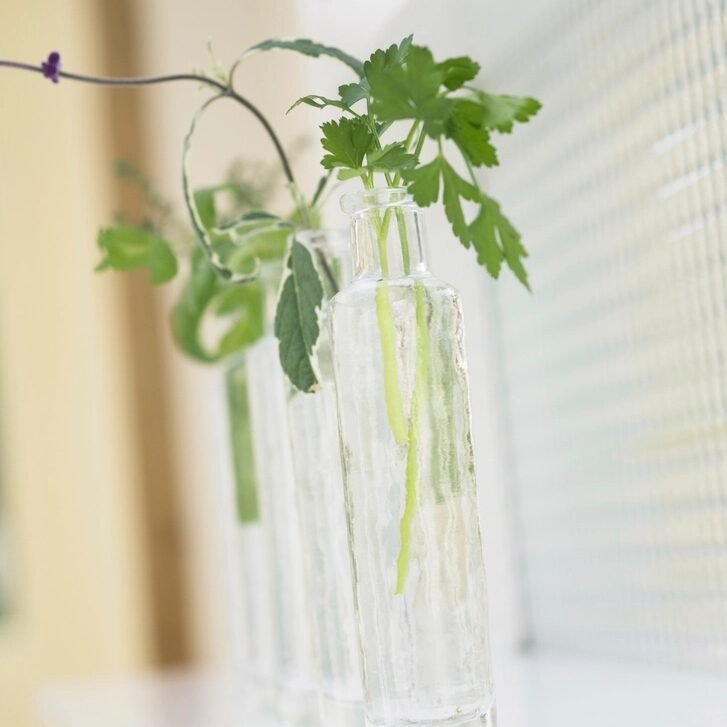
The glass of water. For anything with a real stem — coriander, parsley, mint — trim a centimetre off the bottom, stand the bunch in a glass or a jar with two or three centimetres of water, and put a loose plastic bag or an upturned bag over the top. It sits in the fridge like a bouquet, because that is functionally what it is. Change the water when it clouds. This is the best method for coriander in particular, and it is the difference between a week and a fortnight.
Both of these are better than the drawer, and both are much better than the bag.
What does not work
Airtight containers. Sealing a living leaf in a box with no airflow gets you condensation on the lid and slime on the leaves within three days.
The fridge door. It is the warmest part of the fridge and it swings through a temperature change every time someone wants water.
Chopping in advance. Cutting a leaf multiplies its surface area, and surface area is where water and flavour leave. Chop when you cook, not on Sunday for the week.
Herb by herb
Coriander is the most fragile thing in the bunch and the biggest beneficiary of the glass of water. It also goes on food at the very end — heat destroys it, so a coriander that has been simmering for ten minutes is a wasted coriander regardless of how well you stored it.
Mint is tougher than it looks and holds up well in the cloth wrap. It bruises rather than wilts, so handle it as little as possible; every squeeze is a black spot in two days.
Parsley is the workhorse and will forgive most treatment. It keeps longest of the three in a glass of water and is the one worth buying if you know you will not get to the bunch for a few days.
Onion leaves — the green tops — keep well in the cloth wrap and freeze better than any other herb. Chop them, spread them on a tray to freeze loose, then bag them. They go straight from the freezer into a hot pan.
Reviving a bunch that has already flopped
Not lost. A herb that has wilted but not rotted has lost water, and water is recoverable. Trim the stems, then stand the whole bunch in a bowl of very cold water — ice water if you have ice — for fifteen to thirty minutes. It will stand back up. This does not work on anything blackened or slimy, and it does not work twice, but as a rescue it is remarkable the first time you see it.
If you are not going to get to it
Freeze it rather than watch it die. Chop the herbs, pack them into an ice cube tray, top up with a little water or oil, and freeze. The cubes go straight into a curry base or a soup. It is not the same as fresh — you lose the brightness that makes fresh coriander worth having — but it is far better than a bin, and for anything that gets cooked it is honestly fine.
None of this is difficult. It is one decision, made in the first ten minutes, repeated. Get the bag off.