
Picking a ripe Alfonso mango
The Alfonso season is a few weeks long and there is no second chance at it. Colour tells you almost nothing; the smell at the stem tells you everything. How to choose one, how to finish it at home, and the one thing that ruins it permanently.
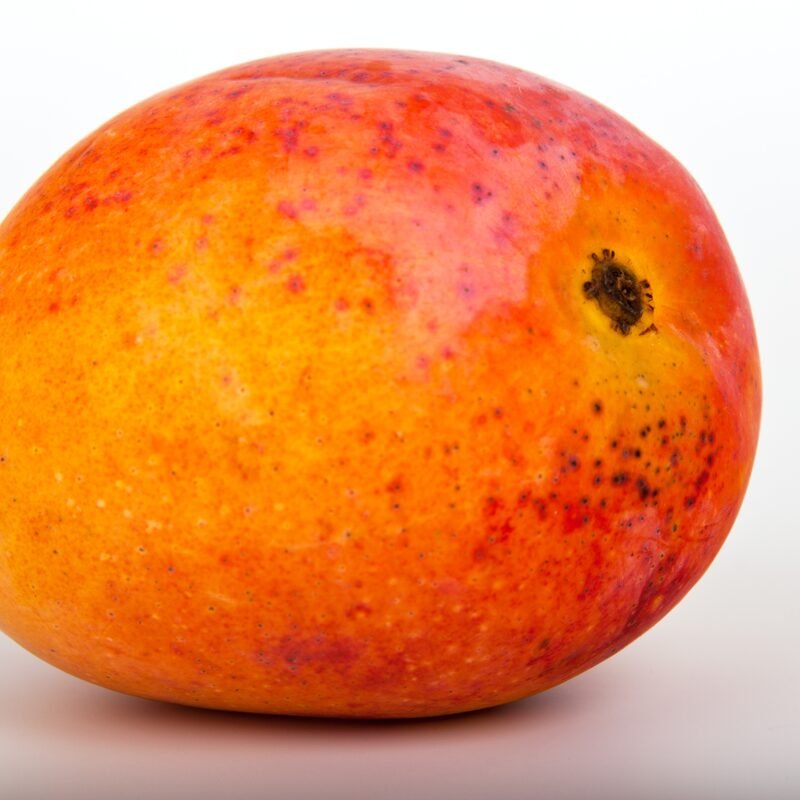
There are sweeter mangoes than the Alfonso and there are certainly cheaper ones. What the Alfonso has is the perfume — a smell that fills a room from a closed box — and that is what people queue for and pay for. The season runs a few weeks in the Indian summer and then it is over until next year, so there is a certain pressure on getting the choice right.
The good news is that choosing an Alfonso is easy once you stop using your eyes.
Colour is a trap
Everyone reaches for the yellowest, most uniformly golden fruit in the box. It is the wrong instinct. Skin colour on an Alfonso is driven partly by variety and partly by how it was handled after picking, and a mango can be beautifully yellow and completely flat inside. The most fragrant mango in a box is frequently one of the plainer-looking ones, still carrying green at the shoulder.
Smell the stem end
This is the test. Hold the fruit with the stem end — the shoulder, where it hung — up towards your face, a few centimetres away. A ripe Alfonso is unmistakable: sweet, resinous, floral, faintly like turpentine in the best possible way. If you have to press your nose to the skin to catch anything, it is not ready. If you can smell it at arm's length, eat it today.
No smell at all is not necessarily a bad mango. It is an unripe one, and unripe is fixable. A sour or fermented smell is not fixable, and that fruit should stay in the box.
Then feel it
Cup the mango in your palm rather than gripping it with your fingertips — fingertip pressure is how a mango gets bruised, and the bruise shows up as a brown patch three days later. It should give slightly and evenly, the way a ripe peach does. Firm all over means it needs a few more days. Soft in one spot and firm elsewhere means it has been dropped, and that soft spot will be brown inside.
Weight helps too. Two mangoes the same size can differ noticeably in the hand, and the heavier one has more flesh and less fibre.
Finishing it at home
Most Alfonsos are bought before they are ready, which is correct — a fully ripe mango does not survive being moved around in this heat. Leave it out on the counter, out of direct sun, and check it once a day with your nose. Two to four days is typical.
To speed it up, put it in a paper bag, and put a banana in with it. The banana gives off ethylene, the bag holds the ethylene around the mango, and the mango ripens faster. The old trick of burying mangoes in a container of rice or wheat works for the same reason and works well; it just makes it harder to check on them.
The thing that ruins it
Do not put a hard mango in the fridge. This is the one irreversible mistake available to you. Cold arrests the ripening process, and it does not restart when the fruit warms up again. What you get is a mango that eventually goes soft — because soft is what fruit does — without ever developing sugar or perfume. It will look ripe and taste of almost nothing, and there is no way back.
Once it is properly fragrant and giving, the fridge becomes your friend: it holds a ripe Alfonso for two or three more days and an Alfonso is better eaten cold anyway.
Cutting it
There is a flat stone down the middle, so cut alongside it, not through it. Stand the mango on its end with the narrow edge facing you and slice down about a centimetre off centre on both sides. That gives you two cheeks and a middle section with the stone in it.
Score each cheek in a criss-cross without going through the skin, then push the skin inwards from behind and it turns inside out into cubes. For the middle section, peel it and eat it over the sink. That is not a shortcut, it is the correct way to handle it.
What to do with it
Eat it. Cold, plain, with a spoon.
I mean that seriously. Every other use of an Alfonso is a use for the ones that got away from you — the ones that went one day too far. Those are excellent as aamras, as a lassi, as kulfi, or spooned over sticky rice. But do not cook a good Alfonso and do not blend it with anything strong. Heat and dairy both flatten the exact aroma you paid a premium for. Save the recipes for the over-ripe ones, and there will be over-ripe ones, because that is how a short season works.